

It all starts with a drop
.jpeg)
It all starts with a drop
How catalytic investment in Herding for Health is helping scape resilient food systems across Africa
Transforming food systems rarely begins with a large investment. More often, it begins by proving what is possible.
For Herding for Health, that demonstration began with an investment of under USD $50,000 from the John and Katie Hansen Family Foundation in South Africa’s arid Namaqualand region. What started as a practical response to livestock losses has evolved into a community-driven approach now active across seven African countries, improving the management of more than one million hectares of rangeland and gaining traction with governments.
It is a story about what catalytic finance can achieve when it is invested in locally grounded solutions, used to generate evidence, and followed by partnerships capable of scaling proven approaches.
But it is also a story about something even more fundamental: the role of healthy rangelands in securing food, livelihoods and resilience in a changing climate.
Rangelands are food systems
Across Africa, rangelands support millions of people whose livelihoods and food security depend directly or indirectly on livestock. They also provide critical ecosystem services, support biodiversity and play an important role in regulating water and carbon.
Yet these landscapes are increasingly exposed to drought, land degradation and climate variability. For pastoralists and livestock farmers, drought is not simply an environmental challenge, it can mean livestock losses, declining household incomes, reduced food availability and the erosion of productive assets built over generations.
The response therefore cannot be limited to managing drought when it arrives. It must include investing in the resilience of the landscapes and communities before the crisis occurs. This is where Herding for Health offers an important pathway.
Four pillars, one integrated approach
Herding for Health recognises that resilient food systems depend on the health of the entire rangeland system. It brings together four interconnected pillars:
- Healthy rangelands.
- Healthy animals.
- Thriving people.
- Governance and policy.
These are not separate interventions. Healthy rangelands provide productive grazing, support biodiversity and boost ecosystem functions. Healthy animals convert that productivity into food, income and household assets. Thriving people have greater capacity and incentive to steward their natural resources. And effective governance and enabling policy create the conditions for these outcomes to be sustained and scaled.
Together, they provide a framework for addressing food security, climate resilience and biodiversity through the management of the landscapes where these priorities intersect.
Investing in the soil beneath our food systems
At the foundation of this approach is soil health. Healthy soils are critical to productive and resilient rangelands, they support vegetation growth, nutrient cycling, water infiltration and retention, and the capacity of landscapes to recover following drought.
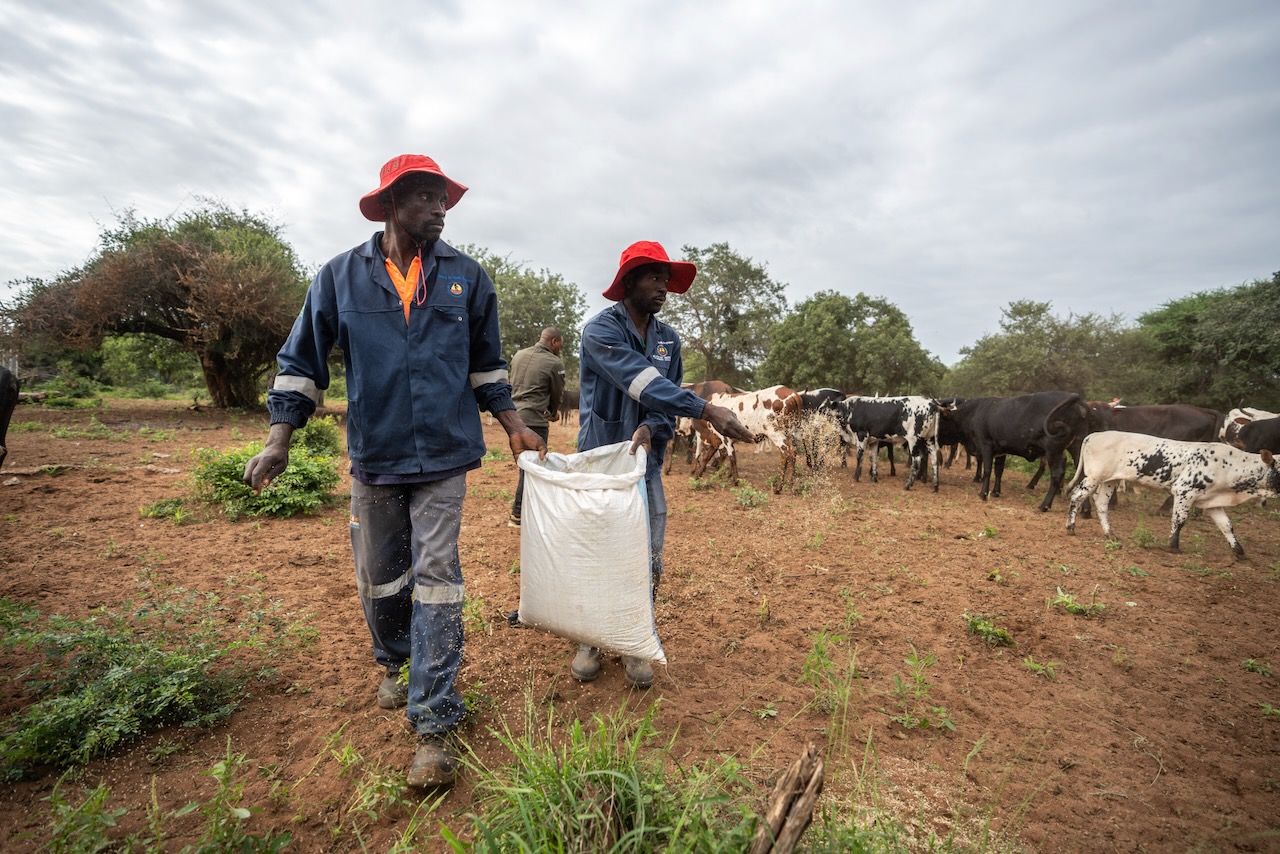
Herding for Health works with communities to improve how livestock interact with the land through planned grazing, strategic herding and resting of grazing areas. These practices allow vegetation to recover and increase ground cover, helping reduce erosion and improve the ability of rainfall to infiltrate the soil, particularly important in dryland systems.
Rainfall may be unpredictable, but land management can influence what happens when that rainfall arrives. Maintaining vegetation and ground cover helps slow runoff, protect topsoil and improve water infiltration. Over time, healthier soils support more productive vegetation, which provides better forage for livestock and strengthens the resilience of the entire production system.
The objective is not simply to produce more grass. It is to restore the functioning of the rangeland system so that it can continue to support people and livestock under increasingly variable climatic conditions.
From livestock protection to food-system transformation
The origins of Herding for Health were deliberately practical. In Namaqualand, farmers were losing livestock to predators such as caracal and jackal, a challenge that often led to retaliatory killings of wildlife. Working with the Cape Leopard Trust, Conservation South Africa introduced Anatolian shepherd dogs to protect livestock and reduce conflict.
Work with communities neighbouring Namakwa Park revealed that they experienced fewer predator losses than private farmers, largely because herders actively managed livestock rather than relying primarily on fences. Introducing professional herders to private farms dramatically reduced human-wildlife conflict, prompting a bigger question: if better herding could solve this problem, what else could it solve?
That question led to planned grazing and collective rangeland management. The approach evolved beyond restoration into livestock production and market access. In the Kruger to Canyon landscape, communal farmers faced another barrier to food-system participation: foot-and-mouth disease restrictions had effectively excluded many from formal beef markets. This led to a partnership with the University of Pretoria to better understand the zoonotic spillover in the area and strengthen the scientific evidence.
Subsequently, a strategic partnership with Meat Naturally, a social enterprise spun-off from Conservation South Africa, led to the provision of markets through mobile auctions and a mobile abattoir that helped connect farmers following stewardship principles to markets while addressing food-safety and disease-management challenges.
Within a few years, more than 1,500 farmers across more than 320,000 hectares had signed conservation agreements, generating more than USD $1.5 million in livestock sales. The lesson was becoming clear: restoration, livestock production, market access and food security could be pursued together.
From one demonstration to seven countries
In 2019, Conservation International and Peace Parks Foundation formally launched the Herding for Health Programme, taking the approach into some of Africa’s most important and food-insecure rangeland landscapes. Today, Heding for Health is active across South Africa, Mozambique, Zambia, Zimbabwe, Botswana, Madagascar and Kenya, supported by a dedicated secretariat funded by the COmON Foundation, alongside a growing network of funders and partners supporting implementation across multiple landscapes.
The model has adapted to different ecological, social and institutional contexts, but the underlying principle remains consistent: work with communities to improve livestock management in ways that restore rangelands, strengthen livelihoods and support coexistence between people, livestock and wildlife. This adaptability is central to its potential for scale.
When evidence becomes government action
One of the strongest indicators of the model’s potential is its growing uptake by governments. In Botswana, communities around the Okavango Delta have adopted Herding for Health approaches including planned grazing and mobile bomas to reduce predator conflict, restore grazing areas and support coexistence between livestock and wildlife.
The demonstration has enabled the largest government adoption of the model to date, across three districts and approximately 4.6 million hectares. This represents an important transition: the objective of catalytic investment is not to create projects that depend indefinitely on external funding, but to generate sufficient evidence, local ownership and institutional confidence for solutions to be adopted, financed and sustained at scale.
The pathway is therefore:
Catalytic investment, demonstration, evidence, partnerships, government ownership, scale.
This is the multiplier effect that makes early-stage investment so important.
The return on investment is measured beyond hectares
Herding for Health now has more than one million hectares of rangeland under improved management, with over four hundred thousand livestock registered under improved grazing management. Through its strategic partnership with Meat Naturally, the programme has generated an estimated US$8.4 million in economic benefits for participating communities.
But the return on investment extends beyond these figures. It includes healthier soils and rangelands, improved livestock management, stronger community institutions, reduced human-wildlife conflict, improved market access and greater resilience to climatic shocks.
It also includes something harder to quantify but essential for lasting change: confidence. Confidence among farmers that restoration can support livelihoods. Confidence among governments that community-based approaches can be taken to scale. And confidence among investors and development partners that rangelands can be understood not only as ecosystems requiring protection, but as productive landscapes and critical infrastructure for food security, climate resilience and rural economies.
From a drop to a ripple
The Herding for Health experience offers a broader lesson for transforming food systems. The first investment does not need to finance the entire solution; it needs to create the conditions for the next investment.
A relatively small amount of catalytic capital can support a demonstration, generate evidence and build local ownership. That evidence can attract development partners. Partnerships can mobilise additional resources. Governments can adopt and scale what has been demonstrated. And, over time, an intervention that began at village level can influence landscapes measured in millions of hectares.
This is the potential of catalytic finance, and it is why investment in rangelands should be considered an investment in food-system resilience. As climate pressures increase, the question is not only how much food we produce, but whether the landscapes producing that food can remain productive.
Healthy soils support healthy rangelands. Healthy rangelands support healthy animals. Healthy animals support thriving people. And effective governance and policy can sustain these gains over time.
The next drop
The journey from Namaqualand to seven countries demonstrates what can happen when investment follows evidence and partnerships follow opportunity. The next stage is to build on that foundation, scaling proven approaches, strengthening the evidence base, supporting government ownership and mobilising new sources of finance for rangeland-based food systems.
The opportunity is significant. With the right partnerships, rangelands can move from being treated primarily as vulnerable landscapes requiring protection to being recognised as assets in which we can invest, assets that produce food, sustain livelihoods, conserve biodiversity, store carbon and build resilience to drought and climate change.
It all starts with a drop.
A small investment. A local demonstration. A community willing to try something different. That’s all it took.
One drop built a ripple. Now it’s time to build the wave.
Photo Credit: Peace Parks Foundation
A unique strength of Herding for Health is its partnership nature.
View Partners

